Pip
Pip — The standard smallest price increment for a currency pair — 0.0001 for most, 0.01 for pairs quoted against the yen.
Pips are how forex prices are quoted and how most traders talk about their results. They are also a poor unit for reviewing a trading record, and the reason is worth understanding before you count another one.
In plain English
For most currency pairs a pip is 0.0001 — the fourth decimal place. EURUSD moving from 1.08412 to 1.08512 has moved ten pips. For pairs quoted against the Japanese yen a pip is 0.01, the second decimal place, because the quote convention is different.
Most brokers now quote one extra digit, called a pipette or fractional pip: that last 5th decimal (or 3rd for JPY pairs) is a tenth of a pip. A price of 1.08412 is 1.0841 and 2 tenths, not 1.08412 pips of anything.
What a pip is worth depends on position size and on the pair. For a pair quoted with USD second — EURUSD, GBPUSD, AUDUSD — one standard lot (100,000 units) gives exactly $10 per pip. Scale linearly: 0.79 lots is $7.90 per pip. For every other pair the value depends on the exchange rate at the time, which is why your broker’s number and your arithmetic will differ slightly.
Gold, indices and crypto CFDs do not have pips in this sense at all. Brokers use “points” or “ticks” for them and the size varies by broker and by instrument. Any pip count involving XAUUSD or US30 needs its instrument specification attached to mean anything.
The formula
Pip value per lot (XXX/USD pairs) = $10 · Result in pips = |close price − open price| ÷ 0.0001
- For JPY pairs, divide by 0.01 instead.
- Money = pips × pip value per lot × lots.
- For pairs where USD is not the quote currency, the pip value must be converted at the prevailing rate.
Worked example — the demo account
Ticket #900087 on the demo account, and the reconciliation nobody publishes: GBPUSD short, 0.71 lots, 1.28418 → 1.27383.
| Price move | 0.01035 | 1.28418 − 1.27383 |
|---|---|---|
| In pips | 103.5 pips | 0.01035 ÷ 0.0001 |
| Pip value at 0.71 lots | $7.10 | 0.71 × $10 |
| Expected gross | $734.85 | 103.5 × 7.10 |
| Gross profit on the statement | $734.85 | |
| Commission | −$4.26 | |
| Net P&L | +$730.59 |
$734.85 from the pip arithmetic and $734.85 on the statement. They tie exactly — and the reason they do is worth more than the number.
They tie because this is a GENERATED account and its profits are computed from the displayed prices. On a real statement they usually will not, and you should not expect them to. The price a broker prints is rounded to the instrument’s quoted precision, so a fraction of a pipette disappears in the display while the broker computed your P&L from the unrounded fill. On a 0.71-lot trade that fraction is worth cents; on a 10-lot trade it is worth several dollars, and traders regularly file support tickets about it.
It also only ties this cleanly because GBP/USD is quoted in the account currency, so a pip on one lot is exactly $10. On EUR/GBP from a dollar account there is a conversion in the middle, at a rate the statement does not record, and the two figures cannot be reconciled from the file at all.
Which is the honest version of a lesson worth internalising: your P&L is the authority and your pip count is the approximation, not the other way round.
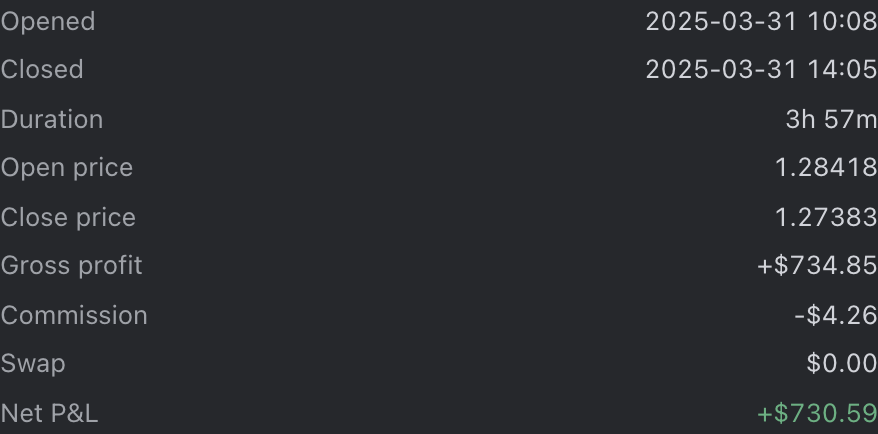
Every figure above is from the demo account TapeSheet ships with — 96 closed trades, generated from a fixed seed. Open the same account →
What this does not tell you
The caveat is the part worth reading. Most tools put it in a footer, if they print it at all.
- Pips are not comparable across instruments. Ten pips on EURUSD and ten pips on GBPJPY are different amounts of money and different amounts of risk. Adding them is meaningless, and “I was up 40 pips this week” is a sentence with no information in it.
- Pips ignore position size entirely. A hundred-pip win on 0.01 lots is $10. The same win on 5 lots is $5,000. Reviewing in pips hides the sizing decision, which is usually the most consequential decision in the trade.
- Pips ignore costs. Spread, commission and swap are real money and do not appear in a pip count. A scalping record that looks profitable in pips is routinely a loss in currency.
- Pips are not risk. A twenty-pip stop on a quiet pair and a twenty-pip stop on a volatile one are wildly different bets. This is what R-multiples fix, and it is why serious review is done in R rather than in pips.
Where TapeSheet shows it
TapeSheet works in account currency throughout, deliberately. Open and close prices for every trade are in the trade detail panel so you can compute a pip count when you want one, but no dashboard figure is denominated in pips — because summing pips across a multi-instrument account produces a number that cannot be interpreted.
Questions
How much is a pip worth?
For a standard lot of a pair quoted against the US dollar — EURUSD, GBPUSD, AUDUSD, NZDUSD — exactly $10 per pip, scaling linearly with lot size. For JPY pairs and crosses the value depends on the exchange rate at the time and must be converted. For gold, indices and crypto CFDs, brokers use points or ticks whose size is set per instrument and varies between brokers.
What is a pipette?
A tenth of a pip — the fifth decimal place on most pairs, or the third on JPY pairs. Brokers quote it for finer pricing. It is the reason a price looks like 1.08412 rather than 1.0841.
Related terms
See your own statement, analyzed
Drop an MT4 or MT5 statement on the page and the whole dashboard renders in about three seconds. No signup, no upload — the file is parsed inside your browser tab and never leaves your device.
Analyze my statementAll glossary terms ·Free trading journal ·MT4 statement analyzer ·MT5 report analyzer